
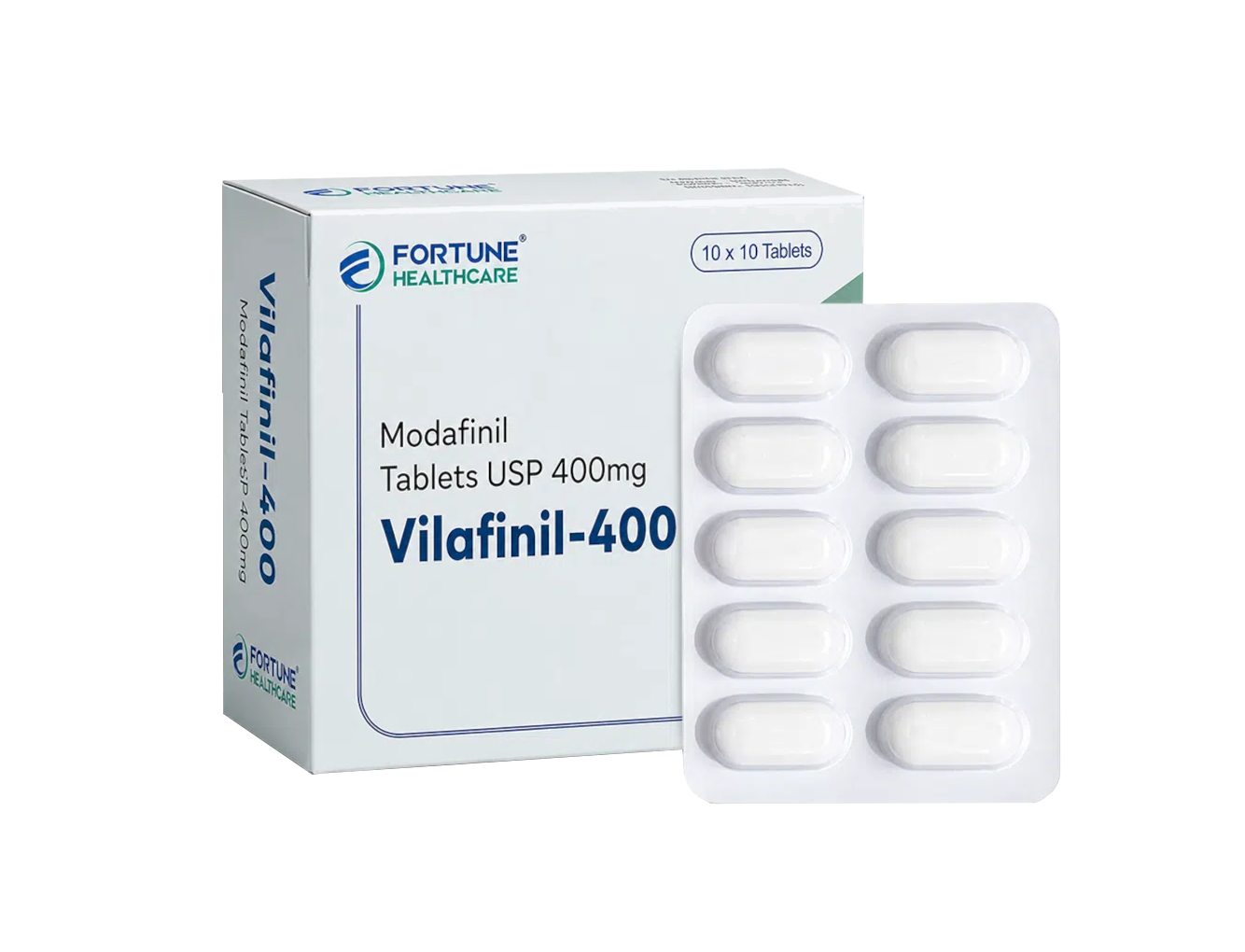
Vilafinil (Modafinil)
Vilafinil is a brand of modafinil, a wakefulness-promoting medicine (eugeroic) commonly used for excessive daytime sleepiness in narcolepsy, obstructive sleep apnea, and shift work sleep disorder. Vilafinil tablets are made in India, and typically contain either 200mg or 400mg of modafinil. It's used off-label as a nootropic or smart drug to boost focus & mental alertness.
Product Overview
Vilafinil is a brand name of modafinil, a wakefulness-promoting medication (eugeroic) used to treat excessive daytime sleepiness associated with narcolepsy, obstructive sleep apnea, and shift work sleep disorder. Tablets marketed as Vilafinil are manufactured in India, principally by Centurion Laboratories (also listed as Centurion Remedies Pvt. Ltd.), and contain modafinil as the active pharmaceutical ingredient, most commonly at a strength of 200 milligrams.
Modafinil, sold originally as Provigil and later under many generic and brand names, is taken by mouth. It is a first-line pharmacologic treatment for narcolepsy in the United States and Europe. Its precise mechanism of action is not fully understood; the best-supported action is atypical inhibition of the dopamine transporter, which modestly raises extracellular dopamine without the rapid, high-amplitude signaling characteristic of classical stimulants such as amphetamine or cocaine. That profile is cited as a reason for comparatively low euphoria and dependence liability, and for its placement in the United States as a Schedule IV controlled substance.
Vilafinil is not a distinct chemical entity. Clinical pharmacology, labeled indications, contraindications, and adverse-effect data therefore follow those of modafinil. Differences among branded generics, where they exist, concern inactive ingredients, tablet appearance, local regulatory status, and—according to informal user reports rather than head-to-head trials—perceived intensity. Vilafinil is less widely distributed in international online and retail channels than better-known Indian brands such as Modalert (Sun Pharma) and Modvigil (HAB Pharma).
Common adverse effects of modafinil include headache, nausea, anxiety, and insomnia. Rare but serious reactions include severe cutaneous adverse reactions such as Stevens–Johnson syndrome. The drug is contraindicated in people with known hypersensitivity to modafinil or armodafinil and is not recommended in pregnancy because of an association with congenital malformations. It reduces the effectiveness of some hormonal contraceptives. Modafinil is a prescription medicine in most jurisdictions and is prohibited in sport by the World Anti-Doping Agency.
Medical Uses
Regulatory labeling for modafinil—and therefore the labeled use of Vilafinil where it is registered as a modafinil product—is to improve wakefulness in adults with excessive sleepiness due to three conditions. The medicine does not treat the underlying cause of obstructive sleep apnea and is not a substitute for continuous positive airway pressure (CPAP) or other primary airway therapy.
Narcolepsy
Narcolepsy is a disorder of sleep–wake regulation marked by excessive daytime sleepiness and, in type 1 disease, cataplexy. Modafinil is a first-line option for sleepiness in adults. It has not been shown to treat cataplexy; sodium oxybate, pitolisant, or antidepressants are used for that symptom when needed. In pivotal trials of the originator product, a greater proportion of patients on modafinil than on placebo were rated improved on clinician global impression and showed better maintenance of wakefulness test scores.
Obstructive sleep apnea
In obstructive sleep apnea (OSA), modafinil is indicated as an adjunct for residual excessive sleepiness in patients who are already treated for the airway obstruction, typically with CPAP. Labeling emphasizes that it is not treatment for the obstruction itself. Residual sleepiness remains common even among adherent CPAP users, which is the clinical niche for a eugeroic.
Shift work sleep disorder
Shift work sleep disorder involves sleepiness during scheduled work hours and impaired sleep during the allotted sleep period, usually in night or rotating shift workers. The labeled regimen is a single dose taken about one hour before the start of the work shift. Trials showed improved night-time performance and reduced lapses on the psychomotor vigilance test relative to placebo, without converting the underlying circadian misalignment.
Available forms
Vilafinil is marketed as oral tablets. Product listings and export catalogs most often describe 200 mg tablets packed in strips of ten. A 20 mg listing appears on at least one Indian consumer pharmacy site and is inconsistent with the dominant 100 mg and 200 mg strengths used worldwide for modafinil; 200 mg is the strength discussed in manufacturer-oriented and wholesale listings. Originator and most generic modafinil tablets are 100 mg or 200 mg. Tablets are swallowed whole and may be taken with or without food.
Off-label and investigational uses
Modafinil is widely used outside labeled indications. Evidence quality varies, and none of the following is an approved use of Vilafinil as such.
- Multiple sclerosis–related fatigue. Some guidelines and trials support a modest effect; results are mixed and the benefit is smaller than for narcolepsy.
- Attention-deficit hyperactivity disorder. Trials in adults and children have been mixed. Modafinil is not FDA-approved for ADHD. A pediatric program was halted after serious rashes, including Stevens–Johnson syndrome.
- Bipolar and unipolar depression. Adjunctive use for residual sleepiness or as an augmenting agent has shown small average effects in meta-analyses; it is not a stand-alone antidepressant and can theoretically destabilize mood in bipolar disorder.
- Cognitive enhancement in healthy people. Students and professionals use modafinil as a so-called smart drug. Controlled studies in non-sleep-deprived volunteers show inconsistent, usually small effects on attention, planning, or working memory, with little evidence of broad IQ-like improvement.
- Mental health conditions. Explored with limited or mixed data in cocaine and methamphetamine use disorders, negative symptoms of schizophrenia, myotonic dystrophy sleepiness, and postural orthostatic tachycardia syndrome.
History
Modafinil (Vilafinil) was developed in the 1970s at Laboratoire L. Lafon in France, building on work by the neurophysiologist Michel Jouvet on sleep–wake pharmacology. Adrafinil was introduced first; modafinil, a cleaner and more predictable successor, was approved in France in 1994 as Modiodal. The United States Food and Drug Administration approved Provigil (Cephalon) on 24 December 1998 for narcolepsy. Indications for obstructive sleep apnea and shift work sleep disorder followed. Armodafinil (Nuvigil) was approved in 2007.
Cephalon acquired Lafon and later became part of Teva. United States generic entry for modafinil occurred after patent litigation, with generics widely available from 2012. Indian manufacturers then supplied a large share of the global generic market. Centurion Laboratories introduced the Vilafinil brand as one of several domestic and export labels for 200 mg modafinil tablets. It never achieved the international recognition of Sun Pharma’s Modalert or HAB’s Modvigil.
Off-label use as a cognitive enhancer expanded in the 2000s among students, software workers, and some military and medical settings. The World Anti-Doping Agency added modafinil to its prohibited list after high-profile sporting cases in the early 2000s.
Society and culture
Brand names
Originator and major trade names for modafinil include Provigil (United States and several other markets), Modiodal (France, Japan, and elsewhere), and Alertec (Canada). Indian and export brands include Modalert, Modvigil, Modafinil-n, Modawake, Vilafinil, and many others. Armodafinil is sold as Nuvigil, Waklert, and Artvigil. The name Vilafinil refers specifically to the Centurion preparation and should not be confused with similarly spelled drugs such as vilazodone (an antidepressant) or viloxazine (a norepinephrine reuptake inhibitor used for ADHD).
Manufacturer
Centurion Laboratories Private Limited (also appearing as Centurion Remedies Pvt. Ltd. on some packs and wholesale listings) is an Indian pharmaceutical firm that markets Vilafinil. Public discussion of the brand on consumer and nootropic websites has sometimes questioned consistency and the firm’s broader product quality record; those claims are anecdotal and are not a substitute for batch-level regulatory testing. Where the product is legally dispensed, quality is the responsibility of the local regulator and the manufacturer’s good-manufacturing-practice system.
Legal status
Legal classification follows that of modafinil, not the brand name:
- United States: Schedule IV controlled substance; prescription only.
- United Kingdom and much of the European Union: prescription-only medicine.
- Canada: prescription only.
- Australia: Schedule 4 prescription-only; pregnancy category D.
- Several countries in Asia and Eastern Europe treat modafinil as a psychotropic with tighter import controls.
Importation without a valid prescription is illegal in many jurisdictions even when the product is a licensed generic in the country of manufacture. Online sales of Indian generics, including Vilafinil, occupy a legally gray or overtly unlawful space in destination countries. This article does not provide purchasing advice.
Sport
Modafinil is prohibited at all times by the World Anti-Doping Agency as a non-specified stimulant. Athletes require a therapeutic use exemption for legitimate medical use. Detection windows extend well beyond the duration of subjective effects because of the half-life and metabolite profile.
Economics
Originator Provigil was historically expensive in the United States, often tens of dollars per 200 mg tablet before widespread generic competition. Indian generics, including Vilafinil, are sold domestically and in export catalogs at a small fraction of that price. Retail figures circulating on wholesale sites have been on the order of one United States dollar per 200 mg tablet or less in bulk, with substantial variation by vendor and year. Price is not a marker of approved status in the buyer’s country.
Research
Research on modafinil continues in several areas. Findings apply to the molecule and not to any single brand.
- Cognition. Systematic reviews in healthy, non-sleep-deprived adults find small and task-dependent benefits, most often on executive attention or planning, with substantial study heterogeneity and possible publication bias.
- Psychiatry. Adjunctive trials in major depression and bipolar depression report modest improvements in residual sleepiness and some mood measures. Schizophrenia trials targeting negative symptoms and cognition have been small and inconsistent.
- Addiction medicine. The rationale is that a weak DAT inhibitor might reduce cocaine or methamphetamine use. Results have been mixed; modafinil is not an approved treatment for stimulant use disorder.
- Military and occupational settings. Armed forces have studied eugeroics for sustained operations. Ethical debate concerns coercion, long-term safety, and fairness in civilian professions.
No large randomized trial has compared Vilafinil with Provigil, Modalert, or Modvigil on pharmacokinetic bioequivalence in a publicly prominent journal. Informal comparisons that describe Vilafinil as “medium strength” relative to Modalert rest on user forums rather than controlled evidence.
Contraindications
Modafinil (Vilafinil) is contraindicated in patients with known hypersensitivity to modafinil or armodafinil. Many labels also advise against use in people with rare hereditary problems of galactose intolerance, total lactase deficiency, or glucose–galactose malabsorption when tablets contain lactose.
Use is not recommended in pregnancy. Observational data have associated first-trimester exposure with major congenital malformations, including cardiac defects, hypospadias, and congenital torticollis. Regulatory communications in Europe, North America, and Australia have tightened pregnancy language over time. People who can become pregnant are generally advised to use effective contraception during treatment and for a period after the last dose; hormonal contraceptives may be less reliable (see Interactions).
Caution is advised in uncontrolled hypertension, recent myocardial infarction, left ventricular hypertrophy, and other significant cardiac disease, because the drug can raise heart rate and blood pressure. It is not approved for children in the United States for any indication. Severe hepatic impairment requires a reduced dose; geriatric patients may need lower doses because of reduced clearance.
Adverse effects
In placebo-controlled trials of modafinil for approved sleep disorders, the medicine was generally well tolerated. Discontinuation because of adverse events was uncommon. Effects listed below are those of modafinil and are expected to apply to Vilafinil.
Common adverse effects
The most frequent events, typically in the 5–10% range and higher than placebo in pooled labeling, include:
- Headache (the single most common complaint; sometimes described as pressure-like)
- Nausea and other gastrointestinal symptoms (dyspepsia, diarrhea, dry mouth, decreased appetite)
- Nervousness, anxiety, or agitation
- Insomnia, particularly if the dose is taken late in the day
- Dizziness
- Rhinitis or nasopharyngitis
- Back pain
Most of these lessen after the first days of treatment. Hydration and morning dosing are commonly suggested measures for headache and insomnia, though they are not substitutes for medical advice.
Serious adverse effects
Serious cutaneous adverse reactions have been reported, including Stevens–Johnson syndrome (SJS), toxic epidermal necrolysis (TEN), and drug reaction with eosinophilia and systemic symptoms (DRESS). These events are rare but can be fatal. Labeling instructs discontinuation at the first sign of rash unless the rash is clearly unrelated to the drug. Multi-organ hypersensitivity and angioedema have also been reported.
Psychiatric reactions—including mania, delusions, hallucinations, suicidal ideation, and aggression—have occurred, more often in people with a prior psychiatric history but also in those without. New or worsening depression or psychosis is a reason to stop the drug and seek care.
Cardiovascular effects include increases in heart rate and blood pressure. Chest pain, palpitations, and dyspnea have been reported, sometimes in patients with mitral valve prolapse or left ventricular hypertrophy. Blood pressure should be monitored in treated patients.
Tolerance, dependence, and misuse
Modafinil (Vilafinil) produces psychoactive effects and is classified as a Schedule IV substance in the United States because of a recognized, though comparatively modest, potential for misuse. It does not produce the intense euphoria of cocaine or amphetamine in most users, and physical dependence with a florid withdrawal syndrome is uncommon. Psychological reliance, rebound sleepiness on abrupt cessation after long use, and diversion for cognitive or occupational performance are documented. People with a history of substance use disorder warrant extra caution.
Overdose
Reported overdoses have involved excitation, insomnia, agitation, tachycardia, hypertension, and gastrointestinal disturbance. Fatalities from modafinil alone are rare; mixed overdoses are more dangerous. There is no specific antidote. Management is supportive.
Interactions
Modafinil is a substrate and a moderate inducer of CYP3A4 and an inhibitor of CYP2C19, with additional weaker effects on other cytochromes. Clinically important consequences include:
- Hormonal contraceptives. Induction of CYP3A4 can reduce plasma concentrations of ethinylestradiol and similar steroids. Additional or alternative contraception is recommended during treatment and for one month after stopping.
- Cyclosporine and other CYP3A4 substrates. Levels of cyclosporine and some other 3A4 substrates may fall. Midazolam, triazolam, and certain calcium-channel blockers and statins can be affected.
- CYP2C19 substrates. Phenytoin, diazepam, propranolol, omeprazole, and clomipramine may have increased exposure.
- Other CNS active drugs. Co-administration with monoamine oxidase inhibitors has not been systematically studied. Alcohol can add to dizziness or impair judgment and is generally discouraged. Combination with other stimulants increases cardiovascular load.
- Strong CYP3A4 inducers or inhibitors. Rifampin, carbamazepine, phenobarbital, and chronic alcohol use may lower modafinil levels; ketoconazole and similar inhibitors may raise them.
Pharmacology
Pharmacodynamics
The mechanism by which modafinil promotes wakefulness is incompletely known. In vitro it binds the dopamine transporter (DAT) and inhibits dopamine reuptake, with human DAT Ki values in the low micromolar range—weaker than cocaine or methylphenidate. In vivo this produces a modest rise in extracellular dopamine in cortex and striatum. Modafinil is not a classical dopamine-releasing agent and has low affinity for the norepinephrine and serotonin transporters.
Secondary or downstream effects reported in animals include increased activity in orexin (hypocretin) neurons, elevated hypothalamic histamine, enhanced glutamatergic transmission, and reduced GABAergic tone in selected regions. These changes are thought to contribute to a more “wake-like” activation pattern than that of amphetamines, which more globally increase locomotor activity and produce stronger reinforcing effects. Modafinil is not a direct agonist at dopamine receptors.
Pharmacokinetics
After oral administration, modafinil is absorbed with peak plasma concentrations at about two to four hours. Food can delay the peak slightly without a large change in overall exposure. Apparent bioavailability is incomplete. Plasma protein binding is about 60%, mainly to albumin.
Modafinil is a racemate. The R-enantiomer (armodafinil) has a terminal half-life on the order of 10–17 hours; the S-enantiomer is cleared much faster (about 3–5 hours). After a racemic dose the circulating drug later in the day is therefore enriched in the R-form. Steady-state is reached in two to four days with once-daily dosing.
Metabolism is hepatic. Major pathways are amide hydrolysis to modafinil acid and S-oxidation to modafinil sulfone; neither metabolite accounts for the wake-promoting effect. Cytochrome P450 enzymes involved include CYP3A4, CYP2C19, CYP1A2, CYP2B6, and CYP2C9. About 80% of a radiolabeled dose appears in urine, mostly as metabolites; less than 10% is unchanged modafinil. Apparent half-life of the racemate is about 12–15 hours.
Severe hepatic impairment approximately doubles exposure; labels recommend halving the dose. Renal impairment has less effect on parent drug but increases metabolite levels. Elderly patients may have reduced clearance. Sex differences in Cmax have been reported, with somewhat higher concentrations in women.

Don't see the answer you are looking for?
No problem! Just drop a message and we will get back to you soon.
Contact usFrequently Asked Questions
Vilafinil (Modafinil) is a wakefulness-promoting medicine. The FDA has approved it for excessive daytime sleepiness from narcolepsy, obstructive sleep apnea (as an add-on to treatments like CPAP), and shift-work sleep disorder. It does not treat the underlying condition—it only helps people stay awake. Many people also use it off-label for ADHD, fatigue, or as a “smart drug.”
It comes as 100 mg and 200 mg tablets. The usual adult dose for approved uses is 200 mg once daily—in the morning for narcolepsy or sleep apnea, or about 1 hour before a night shift for shift-work disorder. Doses up to 400 mg have been used, but extra benefit is not consistently shown. Take it with or without food; food can delay onset a little.
The most frequently reported ones are headache, nausea, nervousness/anxiety, insomnia, dizziness, diarrhea, decreased appetite, back pain, and a stuffy or runny nose. Headache and insomnia are especially common. Most effects are mild and often improve after the first weeks.
Most people feel it in 30–60 minutes. Effects typically last 8–12+ hours. The half-life is about 15 hours, so it can take roughly 3 days to leave the system after the last dose. Taking it too late in the day is a common reason people can’t sleep.
Yes—it is classified as a central nervous system stimulant, though it feels different from amphetamines for many people (less jittery, less of a crash). It is a Schedule IV controlled substance because of some potential for misuse. Dependence and withdrawal are possible but generally considered lower-risk than with classic stimulants like Adderall.
Both promote wakefulness, but they have different chemistry and risk profiles. Adderall is an amphetamine with higher abuse potential and more classic stimulant side effects. Armodafinil (Nuvigil) is the longer-acting R-enantiomer of modafinil; many people find 150 mg armodafinil similar to 200 mg modafinil. Modalert is a brand of modafinil sold outside the US.
Evidence is mixed. In healthy, well-rested people the cognitive boost is usually modest. It is more clearly useful when someone is sleep-deprived (it helps preserve performance). It can improve focus and reduce fatigue, but it is not a substitute for sleep and does not reliably raise IQ. Some people also report overconfidence—feeling sharper than they actually perform.
Official literature says the wakefulness effect does not show clear tolerance in the usual sense. Anecdotally, some long-term users say the “boost” or mood/focus effect feels weaker over time, especially with daily use, poor sleep, dehydration, or low-quality product. Many people take occasional days off.
Yes. Modafinil can make hormonal contraceptives less effective, so backup contraception is often recommended during use and for about a month after stopping. It can also interact with certain other medicines (including some blood-pressure drugs, antifungals, and seizure medicines). Combining it with lots of caffeine often increases jitteriness and headache. Alcohol is usually discouraged. Always check with a doctor or pharmacist.
It is not approved for children under 17. People with a history of serious rash to modafinil or armodafinil, certain heart problems, uncontrolled high blood pressure, or some psychiatric conditions may be advised against it. Rare but serious risks include severe skin reactions (including Stevens-Johnson syndrome), multi-organ hypersensitivity, psychiatric symptoms (anxiety, mania, hallucinations, suicidal thoughts), and effects on the heart. Safety in pregnancy is not established. Stop and get medical help for rash, swelling, trouble breathing, chest pain, or sudden mood/psychosis changes.